129: The Billionaire Escape Plan — Why the Ultra-Rich Are Building Underground Cities
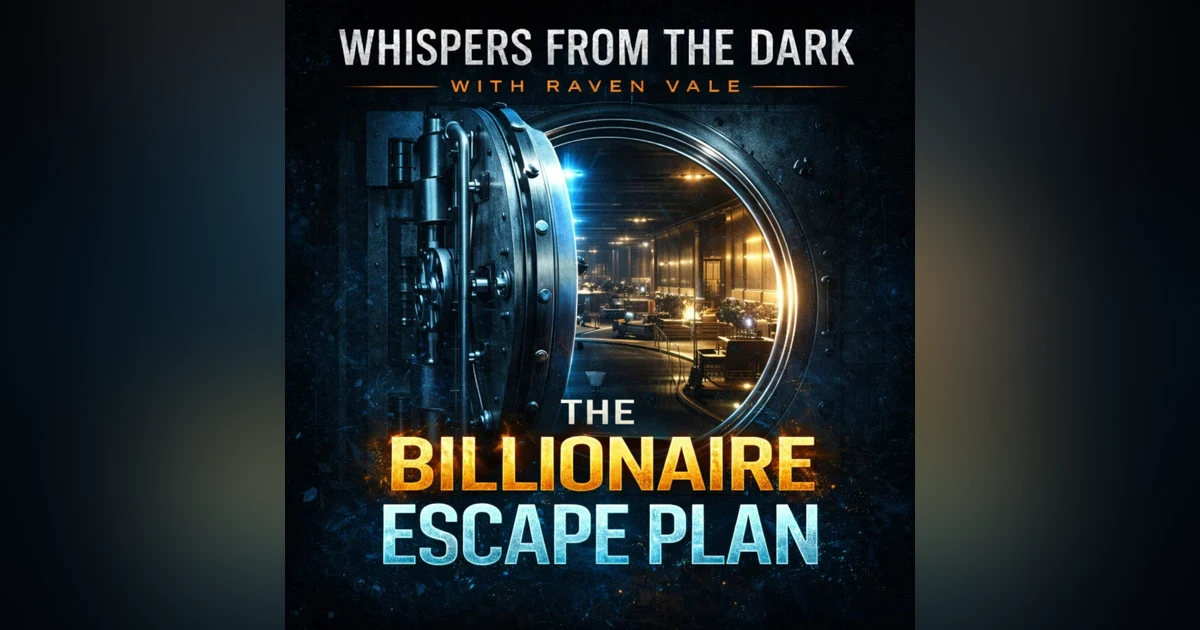


There is a particular kind of door you will never see. It is not marked on any map. It is not guarded by visible security. It is buried — beneath estates, beneath mountains, beneath fields where no structure is visible for miles in any direction. Behind it are rooms stocked for decades. Water systems independent of municipal infrastructure. Air filtration rated for nuclear fallout. Medical facilities. Hydroponic farms. Artificial sunlight cycling on a programmed clock. And someone very wealthy is already holding the key. In this episode of Whispers From the Dark, host Raven Vale investigates the billionaire bunker phenomenon — the documented, large-scale movement among the world's ultra-wealthy to build survival infrastructure at a scale human history has never seen before. This is not speculation assembled from anonymous sources. Former intercontinental ballistic missile silos in the American Midwest have been purchased and converted into luxury survival condominiums, their reinforced concrete walls now protecting million-dollar residential units. Remote estates in New Zealand — chosen specifically for geographic isolation and political stability — have attracted public attention when their strategic purpose became apparent. Silicon Valley executives have acquired land in regions identified by analysts as geopolitically stable. Private islands have been outfitted with independent power generation, desalination systems, satellite communication, and agricultural infrastructure sufficient to sustain their inhabitants indefinitely. Raven opens with the history of fortress psychology — the consistent, cross-cultural pattern by which power has always built walls when uncertainty rises — and traces that impulse from medieval castles and mountain monasteries directly into the present, where the same psychology expresses itself in biometric entry systems and underground swimming pools. She examines the psychology of extreme preparation: why people with access to sophisticated global risk analysis think differently about low-probability, high-consequence scenarios than the rest of us do, and how that thinking produces what looks, from the outside, like either extraordinary rationality or extraordinary anxiety — or both simultaneously. The episode investigates what luxury bunkers actually look like — the hydroponic farms and surgical suites and behavioral psychology-informed architectural choices and simulated skylines — and asks what it reveals about human values when survival is engineered not merely to preserve biological function but to preserve a specific quality of life. Raven examines the industry that has grown up around elite survival preparation: the security consultants, crisis forecasters, and subterranean architects who profit from sustained anxiety, and the way resilience has become a new form of status competition among people whose previous competitive landscape was yachts and private jets. The episode confronts the social contract problem at the center of bunker culture: the implicit lifeboat mentality revealed by a class of people who have quietly built exits while the general population they share civilization with has not been offered the same option. The existence of the plan — not its execution, but its existence — is what erodes the social trust that complex societies depend on. It draws historical parallels to Cold War command bunkers, plague-era noble retreats, and revolutionary-era capital flights — and notes that what is different now is not the impulse but the technology, which makes the option genuinely permanent rather than temporary. And it closes with the question that survives all the economics and psychology and history: when the door closes, and the air systems engage, and the screens switch on to simulate a sunrise over a coast you selected from a catalog — is that safety? Or is it exile from the one thing that cannot be engineered underground? This episode is for anyone who has ever: — Read about billionaire bunkers and wondered what they actually know — Felt the particular unease of realizing that not everyone is in the same boat — Asked whether the ultra-rich's preparation reveals something about how fragile civilization actually is — Wanted to understand the psychology behind extreme wealth and extreme risk aversion — Sensed that the social contract is under strain in ways that are not being spoken about directly The door is already there. Whether it ever needs to close is the question still being written. Whispers From the Dark — available wherever you listen to podcasts. billionaire bunkers luxury survival bunkers ultra rich doomsday prep billionaire escape plan underground bunkers wealthy doomsday bunker billionaire elite survival bunkers why billionaires are building bunkers billionaire New Zealand bunkers luxury underground compound missile silo converted bunker private island survival infrastructure billionaire resilience planning doomsday preppers wealthy elite survival architecture survival bunker inside look billionaire fear collapse social contract billionaires underground bunker design luxury catastrophe preparation ultra rich bunker as status symbol billionaire escape New Zealand geopolitical risk wealthy asymmetric risk billionaires digital fortress cybersecurity wealthy what do billionaire bunkers look like inside why are billionaires buying property in New Zealand psychology of extreme preparation among the wealthy how fear became a commodity for the ultra rich what the billionaire bunker trend says about society is civilization more fragile than we think what happens to the social contract when elites escape luxury survival facility behavioral psychology design Cold War bunker parallels to billionaire survival planning can a self-sustaining underground facility support human life indefinitely Why are billionaires secretly building luxury survival bunkers underground? What do billionaire doomsday bunkers actually look like inside? Why are tech billionaires buying land and estates in New Zealand? How do ultra-rich preppers think differently about catastrophic risk? What is the psychology behind extreme wealth and doomsday preparation? How has fear and survival preparation become a status symbol for billionaires? What former missile silos have been converted into luxury survival condominiums? How does billionaire bunker culture erode the social contract? What is the difference between billionaire resilience planning and conspiracy? How does asymmetric risk thinking drive billionaire preparation for collapse scenarios? What historical parallels exist between billionaire bunkers and Cold War survival shelters? Can a private underground facility sustain human life for years without surface infrastructure? What role do behavioral psychologists play in designing elite survival bunkers? How are private islands being used as self-contained survival infrastructure by the wealthy? What does billionaire survival architecture reveal about the fragility of modern civilization? Is billionaire bunker building a rational response to real risk or a self-reinforcing anxiety? What would life actually be like inside a luxury underground survival compound? How has the luxury bunker industry grown around elite fear and uncertainty? What does it mean for democracy when the wealthy can escape scenarios the public cannot? Why do the most powerful people prepare to disappear when civilization becomes unstable? billionaire bunkers luxury doomsday bunker billionaire escape plan underground survival compound elite preppers missile silo bunker billionaire New Zealand doomsday prep wealthy survival bunker inside billionaire collapse prep social contract elites private island survival ultra rich preppers bunker status symbol billionaire resilience planning Why are billionaires building luxury survival bunkers? A: Billionaires building luxury survival bunkers are primarily responding to asymmetric risk thinking — the practice of preparing for low-probability, high-consequence scenarios regardless of their expected likelihood, because the cost of preparation is trivial relative to extreme wealth and the cost of being unprepared for a catastrophic event is unimaginable. People at the highest levels of wealth often have access to sophisticated geopolitical, climate, and security risk analysis that produces a clearer picture of systemic fragility than the general public typically receives. They are also participating in a growing industry of elite survival preparation that has made resilience architecture a new form of status competition. What do luxury billionaire bunkers look like inside? A: Modern elite survival facilities are architectural projects designed by firms applying luxury residential standards to underground construction. They typically include hydroponic farming systems producing fresh food year-round, medical facilities equipped for surgery and chronic care, fitness infrastructure including pools and climbing walls, and advanced air filtration rated for nuclear, biological, and chemical contaminants. Psychological wellbeing features are prominent: screens simulating windows with realistic daylight cycling, ambient soundscapes mimicking natural outdoor environments, and architectural proportions designed in consultation with behavioral psychologists to minimize the subjective experience of confinement. Why are billionaires buying property in New Zealand? A: New Zealand has attracted significant interest from ultra-wealthy individuals as a survival and resilience destination due to its geographic isolation in the South Pacific, political stability, low population density, agricultural capacity, and distance from the regions considered most likely to experience severe consequences in major geopolitical, climate, or conflict scenarios. The country's remoteness makes it logistically difficult to access but also
This has been a Fuzzy LIfe Production


